

Holy Saturday
Silence, sleet, and what we are waiting for...

Sorry for the silence, friends.
The main reason I haven’t had an opportunity to write reflections in the past couple months is because I’ve been caring full-time for a family member who is two and a half years old. The joy and the exhaustion are woven fine.
Each morning, this sweet kiddo, (“M.”) begins my day with the same question, the same lesson in living: “Waiting is hard. What are you waiting for?”
I’m waiting for a lot of things. Most of them, I can’t explain to a toddler right now. To simplify things these past few weeks, my answer has been, “I’m waiting for the frogs to start singing.”
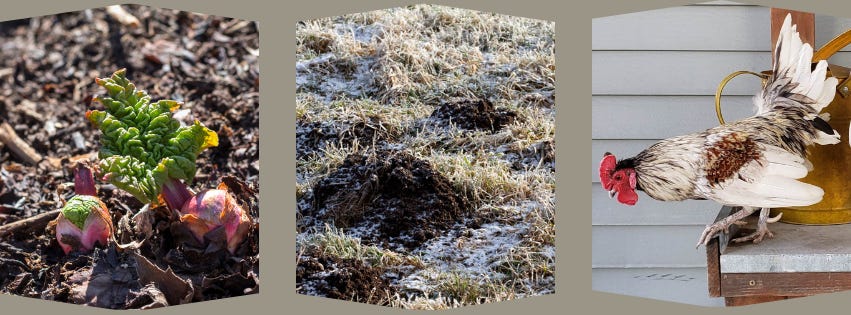
Well, my waiting came to an end. The spring peepers started their thin, otherworldly chorus on this past (unusually warm) Palm Sunday morning. That day, the snow withdrew into the shadowy spots behind the west shed and the woodlot. Inspired, I visited the rows of rhubarb, pulling aside the slimy debris of last year’s leaves to find brave red fists of life pushing their way up through softened soil. As happens every year at this time, I start to believe that the season is shifting for good.
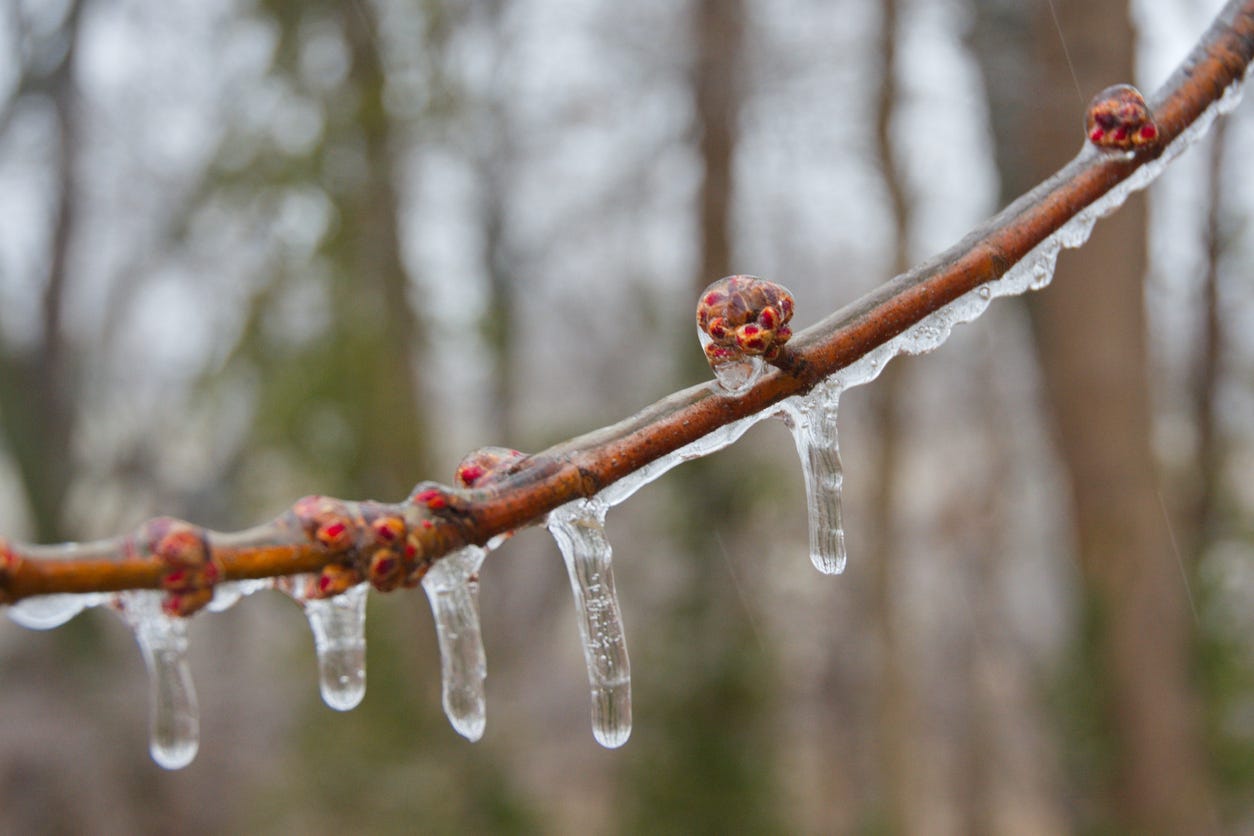
Then, on Monday, the temperatures plummeted again and the rest of Holy Week has been silent. Today, April 4, the world outside my window is coated with a gritty layer of ice.
Holy Saturday comes like this in Minnesota—quiet, grey, and harder than I thought it would be. The frogs that started just stopped. The sun refuses to show itself.
But isn’t Holy Saturday that kind of day, though, no matter where you are? Not the cathartic grief of Good Friday, where the worst has already been done and named. Not the astonishment of Easter yet-to-come, where life breaks open again. This is the day in between, where the story seems to have stalled out in the cold.
We’ve come to understand that the turn from March to April — this in-between time — is the moment when when a lot of creatures die, surprisingly. With our care, they made it through January’s icy wind and February’s deep freezes, but in this lingering bardo, they just can’t keep going. I even believe they know that green warmth is just around the corner, but it’s not enough.
This year, it was a couple of chickens, including our old California-born bantam rooster, Joke. He was almost 13 years old, and little M. helped me feed him in his heated garage hospice quarters through February. We found him still and small in the sick-chicken coop one morning when the temperatures dipped just low enough, just long enough. We gathered him up gently, surprised by how light his body felt. The ground was barely workable, but Pastor Christian took a shovel to it anyway, breaking through the crust of icy grass, making a place in the earth.
Our beloved toddler companion, sock-footed and bundled in a blanket, joined us next to the little hole under the lilac. Unsurprisingly, she asked us the only question that ever really matters: “Why?”
I try to tell the truth in a way that doesn’t dim the world’s shine too soon.
He died, I say. Everything gets old and dies.
“But what happened?”
He was really, really old and even with the heat lamp, he got too cold. Sometimes living things can’t keep going.
Wrapped in a tiny cotton shroud, his tail feathers and one foot sticking out, Joke goes into the ground. We cover our dead with the same earth that is just beginning, tentatively, to wake up. This is where my theology is poised either to become real or to dissolve into sentiment. M. is there to help me sort it out.
“Why are the chickens in the dirt?”
I say the thing that is both true for me and that, at this moment, feels like a wager:
God remembers them, and will turn their bodies into flowers.
But not yet.
My little cousin rolls with this proposition, mostly. I’m grateful, in the moment, for the way kids can hold open a future that adults rush to resolve. But I think that Pastor Christian and I feel the Holy Saturday tension of it, standing there in the sleet.
Because it’s only April 4. Because there are no flowers yet. Because the ground everywhere on this farm still feels more like a grave than a garden.
We pile the dirt up over the little grave of a dead chicken who was our companion in this life, and then we go back inside. Little M. eats a snack of carrot sticks and toast without asking or saying anything more.
Holy Saturday asks us to stay in the silence—to resist the urge to skip ahead to blossoms, to resurrection, to the tidy arc where everything broken is already mended. In Minnesota, Saturday, April 4 asks me to live, for a time, in the unresolved space where death is real and transformation is only promised.
The peepers are still out there, though I have no idea what they’re doing to get through this cold. The rhubarb is still there, waiting under the muck with its tight curl of future tart delight. The tiny lilac buds are discernable on branches over Joke’s final resting place. The soil is still holding what has been given back to it through the deaths of countless living creatures.
The sleet falls over all of it. The faith we cling to today is not the bright “I told you so” of Easter morning. It is the quieter, more stubborn act of simply remaining while songless, even while silent. Of trusting that something is happening beneath the surface of things, even when the surface tells a different story.
On Holy Saturday, we want to say to ourselves and to our children, “What we are waiting for is God, who will turn our grief into unimaginable beauty.” But often the most we can manage is quiet accompaniment.
So, we wait. Not forever, but longer than we would like.
Sometimes without any sounds that hint at the resurrecting power at work in the earth.
Maybe the God of Holy Saturday,
whose heart always aches with ours,
who knows what comes next even when we don’t,
is whispering:
Sorry for the silence.

So beautiful to ponder.
This is a beautiful reflection, Kerri.